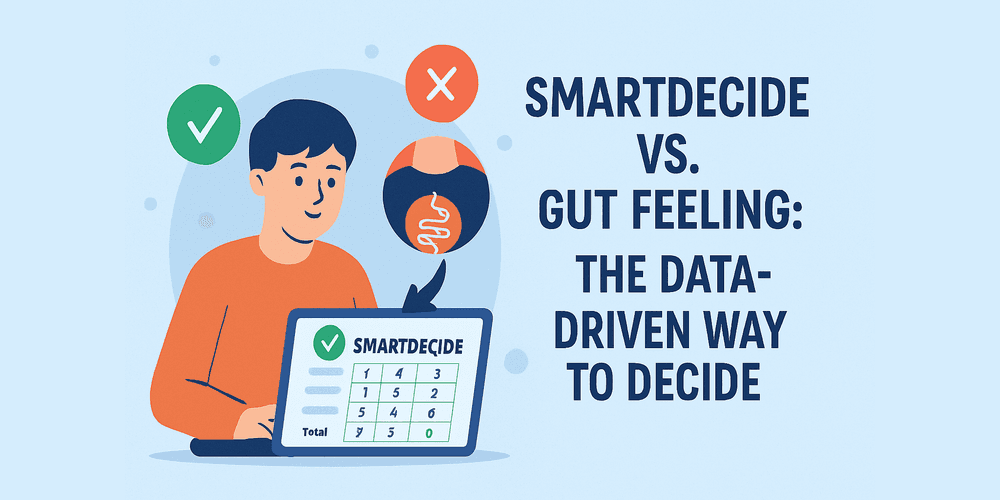
SmartDecide vs. Gut Feeling: The Data-Driven Way to Decide
Written by the SmartDecide Team — where smart choices aren’t just possible, they’re simple.- Dharmik Vaghasiya
Introduction
Have you ever said, “I just went with my gut”, only to regret it later?
You’re not alone. Intuition feels fast, natural, and powerful — and sometimes it works. But when the stakes are high, relying solely on gut feeling can mislead you. Emotions, biases, and assumptions cloud judgment, especially under pressure.
In this guide, we’ll explore why gut-based decisions often fall short — and how SmartDecide empowers you to make clearer, confident, and data-driven choices.
What is “Gut Feeling”?
“Going with your gut” means making a decision based on instinct or emotion rather than analysis.
It’s not always bad. Our brains are wired to take shortcuts called heuristics, which help us act quickly in uncertain situations.
Gut feeling works best when:
- Time is limited
- Stakes are low
- You’ve faced the situation before
But it can be risky when:
- You’re emotionally invested
- The decision is complex or unfamiliar
- The outcome has long-term consequences
4 Problems With Relying on Gut Feeling
1. Emotions > Logic
Gut decisions are influenced by how you feel in the moment — not the full picture.
- A bad day, a persuasive conversation, or a fleeting impression can sway your choice.
- Emotional decisions often lead to inconsistency, regret, and doubt later.
2. Cognitive Biases Creep In
We all carry unconscious biases:
- Confirmation bias: favoring info that supports what we already believe
- Recency bias: giving more weight to the latest information
- Anchoring: overvaluing one initial piece of info
Gut decisions don’t filter these biases — they’re driven by them.
3. Hard to Explain
Try explaining your gut choice to someone:
- Most of the time, you’ll say “It just felt right”.
- If you can’t explain your reasoning, it’s hard to evaluate, learn from, or defend your choice.
4. Regret After the Fact
Relying solely on intuition often leads to post-decision regret.
- “Did I choose too quickly?”
- “Did I miss something important?”
- “Should I have analyzed this more?”
Sound familiar? That’s the cost of guessing instead of knowing.
SmartDecide: The Antidote to Emotional Chaos
SmartDecide doesn’t replace your intuition — it strengthens it with structure and evidence.
It’s a decision-making tool based on MAUT (Multi-Attribute Utility Theory), a proven model used in business, policy, and strategy.
Here’s how it helps:
- Clarify priorities: Define what matters most to you
- Score objectively: Evaluate options against criteria
- See recommendations: Based on your values and weights
- Feel confident: Decisions are logical and personalized
Gut Feeling vs SmartDecide — Side by Side
| Feature | Gut Feeling | SmartDecide |
|---|---|---|
| Driven by emotion | ✅ | ❌ |
| Structured process | ❌ | ✅ |
| Helps avoid bias | ❌ | ✅ |
| Supports multiple options | ❌ | ✅ |
| Matches your priorities | ❌ | ✅ |
| Confidence after decision | ❌ Often doubtful | ✅ High |
Real-Life Example: Choosing Between Two Job Offers
Scenario:
- Job A: Higher salary, long commute, big brand
- Job B: Lower pay, remote, better team culture
Your gut might favor Job A because it “feels bigger and more secure.”
But using SmartDecide:
- Set criteria: Flexibility (40%), Salary (30%), Growth (20%), Team Culture (10%)
- Score each job objectively
- Result: Job B comes out on top — the choice matches your true priorities
Suddenly, you’re not guessing — you’re deciding with clarity.
When Gut Feeling Works — And When It Doesn’t
Intuition is valuable:
- Creative decisions
- Fast-paced environments
- Repeated familiar scenarios
But intuition alone can fail when:
- Decisions are complex
- Long-term consequences matter
- Emotions might cloud judgment
The key is blending gut and data — and that’s exactly what SmartDecide helps you do.
How to Make Decisions Smarter: Step-by-Step
Step 1: Identify Your Priorities
List the 3–5 things that matter most for this choice.
Example: Buying a laptop
- Battery life
- Performance
- Price
- Portability
Step 2: Narrow Down Your Options
- Limit to 3–5 realistic choices
- Reduce mental clutter
- Focus only on options that meet your core needs
Step 3: Assign Weights
Not all criteria are equal. Decide which matters most.
Example:
| Criteria | Weight |
|---|---|
| Battery | 30% |
| Performance | 25% |
| Price | 25% |
| Portability | 20% |
Step 4: Score Each Option
Rate each product or choice objectively (e.g., 1–10 scale).
Step 5: Calculate Weighted Totals
Multiply scores by weights, sum them, and see which option truly fits your priorities.
Step 6: Review and Decide
- Check your results
- Make your choice confidently
- Track outcomes to refine future decisions
Beyond Jobs and Laptops — Where This Works
Decision matrices and SmartDecide are useful in:
- Cars: safety, features, resale value
- Travel: budget, climate, activities
- Software: pricing, usability, integrations
- Home appliances: energy efficiency, capacity, noise level
- Vendor selection: cost, portfolio, turnaround time
Whenever you have multiple good options, structured scoring removes guesswork.
Common Mistakes to Avoid
- Overcomplicating: 4–6 criteria is enough
- Misjudging weights: Align with real priorities
- Scoring bias: Use reliable data
- Ignoring human factors: Comfort, aesthetics, brand preference count
- Neglecting future needs: Anticipate changing priorities
The Psychology Behind Smart Decisions
- Engages both logical and emotional brain
- Externalizes decisions: reduces reliance on memory and instinct
- Numbers provide clarity and justification
- Commit with confidence and reduce second-guessing
Action Plan: Start Making Better Decisions Today
- Pick a decision you’ve delayed
- List your 4–6 priorities
- Assign weights
- Score your options
- See results and decide confidently
Final Thoughts
Decisions shape our lives — from careers, education, and purchases, to relationships and lifestyle.
With structure, framework, and SmartDecide:
- Avoid guesswork
- Reduce stress
- Make smarter, faster, and more confident choices
Stop relying solely on gut feeling or endless research. Start making decisions with clarity, confidence, and insight.
Share: